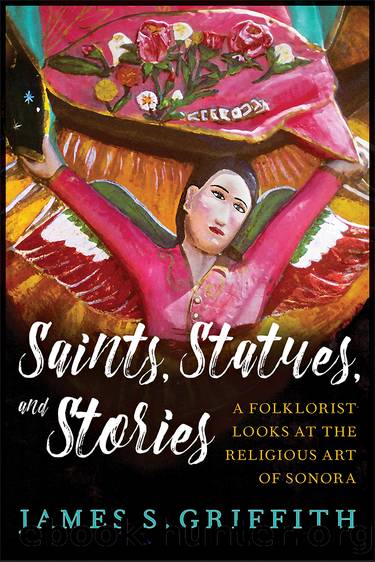
Saints, Statues, and Stories by James S. Griffith
Author:James S. Griffith [Griffith, James S.]
Language: eng
Format: epub
Tags: SOC053000 Social Science / Regional Studies, SOC022000 Social Science / Popular Culture, ART013000 Art / Folk & Outsider Art
Publisher: University of Arizona Press
Published: 2019-10-02T00:00:00+00:00
A probable Oâodham sacred painting at Station of the Cross XII in the Pitiquito mission church. These ochre and kaolin paintings are found on the earliest levels of plaster on the church walls (April 10, 1999).
âº
The following vignettes were chosen to illustrate the notion that these images are connected to their sacred subjects in special ways. The connections between saints and their images can be complex and multidirectional. When I talked with Tacho León about his work as a restorer of sacred statues, he told me that many of the people who brought their art to him believed that damage to the statue reflected some suffering on the part of the saint. This suffering might have been inflicted as a result of having worked a miracle on behalf of the petitioner. The inference here seems to be that, just as God desires a reciprocal act of giving from the human petitioner, so he does from those saints who intercede on behalf of humans.
I was told the following story by members of a family with Sonoran roots, living in the Arizona mining community of Winkelman-Hayden. The father of the family is known in his community for painting saintsâ images, and also for repairing damaged statues. They once owned a house in the flood plain of the Gila River. During a particularly heavy flood one year, the family of five fled the house. When they returned, they found that the water level inside the flooded house had reached higher than five feet, and that the interior water pressure had forced a large refrigerator through the back wall of the building. In an inner room, on what had been the family altar, stood the statues of five saints, each one without its head. A family member explained to me that these saints had sacrificed themselves for the good of the family, one for each family member.
Many images are cared for in special ways. Statues, especially of the Virgin, are often beautifully dressed, as they are all over the Mexican world. Clothing for statues is typically prepared by women, perhaps members of a church organization formed for that purpose. The dresses may be changed regularly, often to coincide with the feast day appropriate to that image. For example, at San Xavier del Bac a group of women take responsibility for creating new clothing for the statue of la Virgen Dolorosa, and they frequently prefer to clothe her in pastel shades rather than the more common black. The clothes on some statutes are preserved; the pilgrimage church in Ocotlán in Tlaxcala has a beautiful special chamber, the camarin, which is devoted to the Virginâs many costumes. It is interesting that this luxurious dressing of images was condemned by the Council of Trent (1545â1563)âa condemnation that was eagerly echoed by the higher clergy in Spanish America. It is equally interesting that, more than three hundred years later, Mexican Catholics still dress their beloved images in the richest and most wonderful garments available (de Ceballos 2009, 25, 28).
Download
This site does not store any files on its server. We only index and link to content provided by other sites. Please contact the content providers to delete copyright contents if any and email us, we'll remove relevant links or contents immediately.
Cecilia; Or, Memoirs of an Heiress — Volume 1 by Fanny Burney(32548)
Cecilia; Or, Memoirs of an Heiress — Volume 2 by Fanny Burney(31947)
Cecilia; Or, Memoirs of an Heiress — Volume 3 by Fanny Burney(31932)
The Great Music City by Andrea Baker(31917)
We're Going to Need More Wine by Gabrielle Union(19035)
All the Missing Girls by Megan Miranda(15962)
Pimp by Iceberg Slim(14489)
Bombshells: Glamour Girls of a Lifetime by Sullivan Steve(14058)
For the Love of Europe by Rick Steves(13934)
Talking to Strangers by Malcolm Gladwell(13350)
Norse Mythology by Gaiman Neil(13349)
Fifty Shades Freed by E L James(13233)
Mindhunter: Inside the FBI's Elite Serial Crime Unit by John E. Douglas & Mark Olshaker(9324)
Crazy Rich Asians by Kevin Kwan(9280)
The Lost Art of Listening by Michael P. Nichols(7494)
Enlightenment Now: The Case for Reason, Science, Humanism, and Progress by Steven Pinker(7306)
The Four Agreements by Don Miguel Ruiz(6745)
Bad Blood by John Carreyrou(6611)
Weapons of Math Destruction by Cathy O'Neil(6267)
